

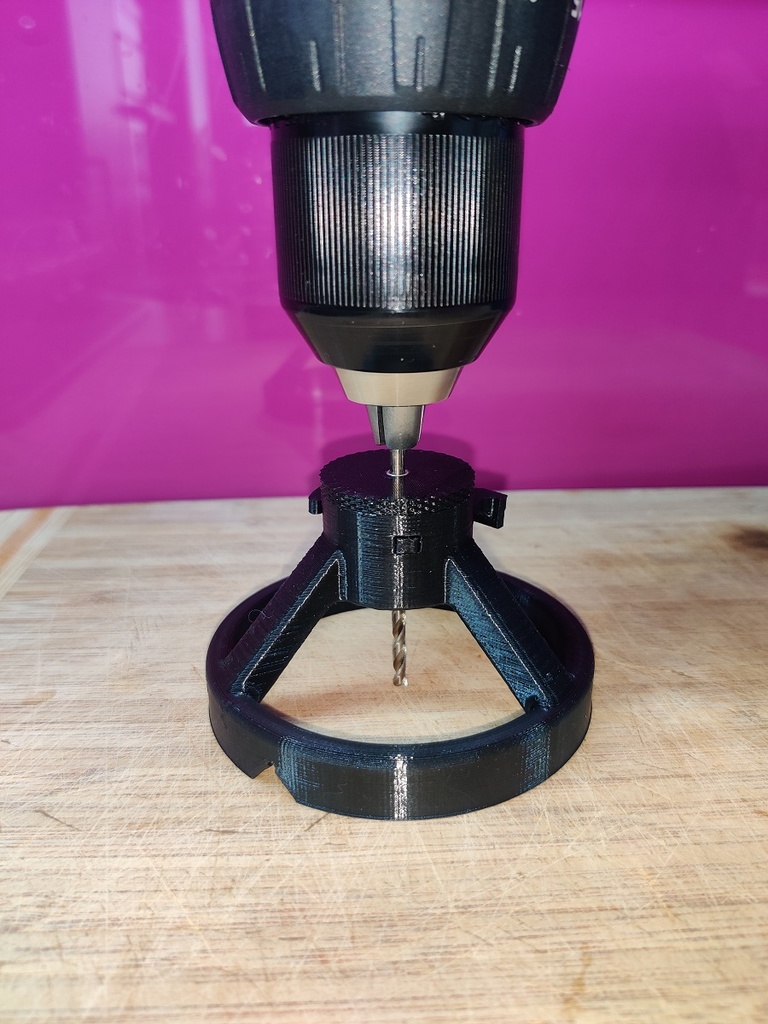
The Vertical Drill Jig Guide on Printables solves one of the most common small-shop problems: getting a clean straight hole when you do not have the work under a drill press. A lot of builds fail quietly at this stage. The part still goes together, but screws lean, dowels bind, brackets sit crooked, and the fix becomes "open the hole a bit" instead of doing it right the first time.
That is why this file deserves more than a quick spotlight. It is a simple bench helper with a clear job, a clear audience, and a strong project-guide angle. If you build furniture, install hardware, repair boxes, mount brackets, or do small workshop jobs with a hand drill, a guide like this can save more frustration than a much fancier accessory.
Public proof is solid for a focused utility tool. During review, the listing showed about 114 likes, 431 downloads, roughly 3,186 visible views, 81 public collections, 7 makes, 7 comments, and 7 visible ratings averaging about 5.00. That is credible traction for a file that exists to make normal drilling jobs cleaner rather than to look impressive on a shelf.
What problem this model solves
Freehand drilling drifts fast, especially on narrow parts, curved surfaces, awkward edges, or repair work where there is not much room for error. This guide gives the bit a cleaner start and a better chance of staying square as the hole begins.
- helps reduce angled starts when drilling vertical holes by hand
- supports cleaner dowel holes, pilot holes, hardware mounting, and repair work
- makes repeat small-shop tasks easier when a full drill press setup would be overkill
- creates a believable ordered-print handoff because geometry and hole accuracy matter more than decoration
Why this design is worth noticing
The best workshop prints often remove a tiny source of slop from a normal workflow. That is what this jig does. It does not replace skill, but it gives the first seconds of the cut more control, and those first seconds usually decide whether the hole stays where you wanted it.
This also gives the article a stronger use-case frame than a generic tool holder or another storage object. Readers can learn when a printed drill guide is enough, when they should add bushings or sleeves, and what kinds of projects benefit most from ordered printing instead of a rough one-off test print.
Who this helps most
- Woodworkers: for straighter pilot holes, dowel prep, and cleaner hardware installs.
- Repair-minded households: for bracket remounts, hinge work, and small fixes where crooked holes make the repair worse.
- Makers without a drill press: who still want more controlled results from a hand drill.
- Shop organizers and fixture builders: who make repeat holes in jigs, holders, and bench add-ons.
What to check before printing or ordering
- Match the bit range: confirm the hole sizes the jig supports and whether your planned bits fit the guide properly.
- Think about wear: a printed guide works best for lighter-duty alignment help; if you expect heavy repeated use, consider whether sleeves or bushings make sense.
- Check surface access: guides like this help most when you can seat them flat and hold them steady during the hole start.
- Use enough wall strength: this is a tool, not decor, so a cleaner stronger print matters more than speed-draft settings.
If you are deciding whether a downloaded workshop file is worth ordering, pair this with how to choose downloaded 3D models that are actually worth outsourcing for printing, the downloaded-model rights guide, and how to hand off a downloaded model without guesswork.
Why ordered printing makes sense here
A drill guide is one of those prints where shape control matters. If the guiding geometry is sloppy, the whole point disappears. Ordered printing makes sense when you want a cleaner more trustworthy bench helper instead of gambling on a rough print that may introduce the same alignment problems you were trying to remove.
Need help from a professional 3D print farm? Reach out to JC Print Farm and they can help.
Need parts printed? Get a quote at quote.jcsfy.com. We ship globally, offer multiple materials, and keep quoting simple.
Common questions
Is a printed drill guide accurate enough to matter?
Yes, for many small workshop jobs the biggest win is simply starting the bit straighter and keeping the early cut from wandering. That alone can improve fit and reduce rework.
Who benefits most from a guide like this?
People doing woodworking, fixture builds, household repairs, and hardware installs with a hand drill instead of a dedicated drill press setup.
When is a simple vertical guide enough, and when do you need a more specific jig?
A simple guide is enough when your main problem is drill wander. Once spacing, repeat offsets, or hinge hardware placement become the real risk, move to a layout-specific jig instead.
Why feature this instead of another storage print?
Because it improves a real making step. Tools that remove alignment error often create more lasting value than another box, tray, or hanger.
Related reading
- Dowel Drill Jig for repeat joinery work
- Hinge Drill Jig for cabinet hardware alignment
- Door Knob Latch Plate Router Jig for door-install work
- How to choose downloaded models worth outsourcing
Ownership and print-offer note
The public Printables page data exposes `excludeCommercialUsage: false`, which is a positive signal, but this pass did not independently confirm the exact human-readable commercial-use wording on the live source listing. Editorial coverage is clear, while broader production rights for the exact file should still be treated as unclear until the source terms are verified directly.